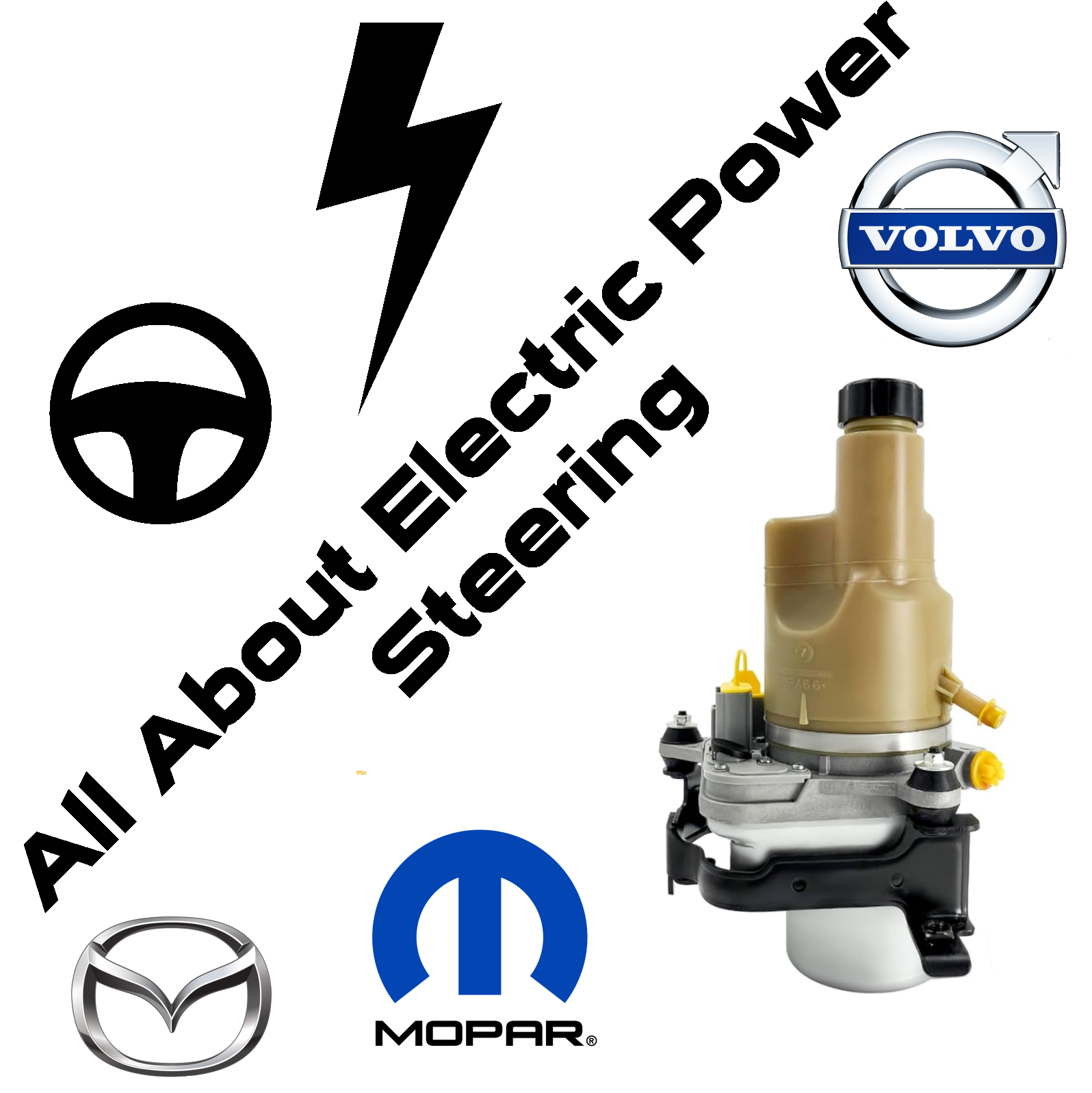
Over the past couple of years I have spent much more time than I ever anticipated learning about electrohydraulic power steering systems. While the electrical side came pretty naturally, the hydraulic side required me to do some homework, and I'm going to share both sides of my findings.
To start, let's look at the fundamentals of a hydraulic power steering system and define some terms.

You have a steering box or rack that is connected to a steering column that allows driver inputs to turn the wheels. The rack or box has a hydraulic valve (also called a quill or spool valve) that takes input load from the steering column and allows fluid to flow to the ram. The direction of flow can reduce the amount of force the driver needs to apply to get the same force at the wheels: thus hydraulically assisted steering. This force we will be referring to as "the load".
There is a pump that is often powered by the crankshaft of the engine (connected via a belt) but in our case we now remove that and use a large electric motor to operate the pump.
We also have a feed line (pump to rack/box) and a return line (rack/box to reservoir, sometimes part of the pump). There is also often a cooler or cooling loop on the return side of the system. Never install a cooler on the pressure side as it can see 2000+ psi of pressure and even more on spikes, which will damage most coolers.
So you're asking yourself, why would electric be beneficial here?
OEM's have different goals than performance enthusiasts, but there are times when what we both want align. In the case of OEM's their push to electric pumps was partially fuel economy (since it always is) and probably also packaging. In the case of the Dodge/Stellantis pumps, I don't believe the 3.6L V6 was developed with a PS pump in the front accessory belt drive because Stellantis had plans to keep that engine longer than they would keep the hydraulic power steering system.
Many new vehicles (including my 2017 1500 Silverado) are electric rack (ie an assist motor directly on the steering rack) and has been trending that way for years. (also due to active cruise control/autonomous driving systems are easier with electric racks).
There's a slight bump in fuel economy due to the fact that the engine's crankshaft is no longer tied to pump flow. If the car needs less assist (based on an algorithm of vehicle speed, steering input, brake input, etc.) then it can turn down the pump, gaining a small amount of overall energy efficiency.
Sizing the pump and crankshaft rpm vs pump rpm is always a trade off; to have good flow and pressure at near idle for parking lot speeds you will be bypassing a lot of flow at higher RPM.
This is one of the largest advantages we've found going electric, you can turn the assist level up at slow speeds and down at higher speeds while not generating additional heat from 'over-pumping' fluid. Most cars that convert do not need a cooler.
Cavitation is basically eliminated, which reduces heat and extends fluid life.
Electric can also be mounted almost anywhere, and in more orientations than a traditional engine mounted pump can.
What are the cons?
Well if you're converting a traditionally belt driven pump, then you'll need to find a solution for bypassing the pump on the serpentine belt.
You'll also need to ensure that your electrical system is up to task. We recommend at least a 160 amp alternator, a healthy battery, and 8 AWG wire from battery to pump power. Any added resistance like cheap/failing breakers or fuses, bad connections, insufficient wire or overly long runs (we aim to keep it within 6' of the battery) will all affect pump performance.
After that there really isn't any; the electric pumps themselves aren't much more money than a quality reman or OEM pump and if you're comparing to a racing pump with a different diameter pulley etc etc, then it's usually cheaper to convert.
So how do electric perform compared to belt driven hydraulic?
In my opinion our test vehicle for this wasn't a good belt driven pump setup to begin with, but it's what we were able to use as a baseline. We had Terence's 198something Gbody with a built small block, T56, bunch of suspension parts and 275 sticky front tires. He built it for road racing (I know, I know) and ran into constant power steering issues, namely keeping it cool enough. He had been through multiple pumps and steering boxes, as fluid burning up from heat would damage seals. He had a standard GM Saginaw style pump off a newer engine and a huuuge like 30 row plate cooler in front of the rad, and this kept it in check for a 20 minute session.
Using an Ecumaster Pro8 ECU as our logging device (which it is amazing at I must add) we are able to log, pressure, temp, flow rate, engine rpm and amp draw of the electric pump. I would have loved to add vehicle speed and steering angle but time and resources did not allow this.
We were able to get track time at our local track, so we set up a slalom course of cones with a few longer sweeping turns and a straight to simulate mixed course driving. Ambient temp was between 15-24*C (60-75*F), dry conditions.

First log we are looking at here is from the mechanical pump and the cooler installed. Our temp sensor stopped working during the start of this test, but it was around 50-60*C (120-140*F) (later test without the cooler pushed it to nearly 90*C (195*F) measured with FLIR temp gun.
You can see the start of the log is driving in a straight line, the squiggly part on the yellow line (pressure) is the first slalom.
Things to note;
peak pressure which is only achieved very briefly is about 960 PSI, on the slalom section the low point is about 400 psi, and the peak is around 800-850 PSI.
Flow rate is extremely consistent, even at idle it's jumping around between 12-13 l/min, where as at 6000+ rpm it's doing around 16 l/min.
Terence's comment here was that the mech pump always felt like too much assist and made the steering feel numb. Granted a different pulley or restrictor may have solved that to a degree, but he never optimized the mechanical pump setup.

Moving on, we have a log from the EPAS system (which is a 2011 Dodge Challenger pump) and everything else the same (still using silly sized cooler).
Things to note:
Pressure is largely the same, it's a little bit lower in some spots vs higher in others but it's nearly impossible to drive exactly the same way with exactly the same forces applied; take away here is that pressure is determined by the load not the pump. More on that later.
Flow rate seems shockingly lower than a mechanical pump right? This is where Terence said the steering feel felt right. So at a second glance now, that means that the mech pump is seriously over doing it.
While pressure and engine RPM no longer correlate, we have a new channel to watch which is amp draw. The peak in this log is 63 amps, and that's at low speed with high steering angle input with a max time around 1 second. Most of the other peaks you see are 40-50 amps or below, and shorter (1/4 to 1/2 second).
We can also observe that pressure and amp draw are nearly directly linked; we will come back to this later as well.
Last thing to notice is fluid temp on the return (post steering box) is 42*C and it did not move. Without a cooler was a few degrees higher but also consistent, each run of the course was about 7 minutes. You can also see the sensor is starting to fail, but let's not dwell on the fact I didn't have a usable spare that day.
So now we have a better understanding of the difference and we like the idea of converting to EPAS, which pump is best?
I built a test bench to be able to back-to-back of all the pumps I could buy or borrow. The first version used a ball valve to control flow, which was tricky to close slow and linear enough. I later switched to a flow control valve, which was better for control but had a 4 psi drop over the valve. I was not able to test all of them on it however and most of these are on the ball valve.
All tests were done on a 12V lithium battery freshly charged.
Let's start with the most common choice, the Volvo.

These can be found in 2004-13 Volvo S30, S40, S60, C30, C40 and the earlier V50's, there is a remote reservoir version but be careful since they can be more easily mixed up with the newer version pumps, that look like this one:

They can operate in limp mode (note the newer ones cannot) but you get more out of them and control of course with a CAN based controller. Many people run these and are fine, and many complain they aren't enough. They do not seem to handle being run at full tilt very long.


Output is a metric thread (M16x1.5mm) fitting with a crush washer, can be adapted to -6 easily.
2 Connectors; Big one is power and ground, small one is control:
12V IGN (Pin 1), CAN Low (Pin 2) and CAN High (Pin 3).

This is with the flow valve, so we can see and plot the relationship between flow rate and pressure. The rise in flow rate when the valve opens and pressure is able to be released does not count and will be ignored for max flow.
Max Pressure: 1650 PSI
Max Flow: 3.23 l/min
Max amp draw: 64.2 amps
Next up is the Mazda 3/5 pump:

These can be found in 2004-2013 Mazda 3 and Mazda 5's; there is a large and important difference from the 2 connector (2011-13) and the older 3 connector versions. The 3 connector version is not a coated board and any moisture that gets in can and will destroy the electrical internals. These pumps are located in the passenger front fender, meaning they can be easily damaged in a front end collision, use caution buying them from a wrecker yard. They are all remote reservoir/fill style.

Output is a metric thread (M14x1.5mm) fitting with a crush washer, can be adapted to -6 easily.
We have a few drift cars locally that use these, even iron block LS cars that are happy with the assist level. Most of the time I'd say they are on the too weak side.

2 connectors that matter, same for both versions. These require a CAN controller to turn on, they do not have a limp mode.
Big one, power and ground. Small 6 pin, 12V ign (Pin 4) CAN High (Pin 5) CAN Low (Pin 6).

This test was done with the ball valve, so little harder to see the relationship.
Max Pressure: 1570 PSI
Max Flow: 1.9 l/min
Max amps draw: 57.3 amps
Next up is the internationally beloved Opel Astra pump

These are found in a ton of Holden/Opel Astra (TRW or ZF type) models from 1998-2006 or 2004-2009 (and according to google a Holden Zafira 2001-05 as well).
They have a M16 threaded output fitting, making converting to -6 easy.
They are a bit harder to get in North America since they weren't sold here, but also not that hard thanks to ebay, amazon and alibaba.
To my knowledge they are all integral reservoir.
Now they aren't really controllable, there is 2 wires for enabling the pump on a 3 pin connector. Pin 2 (black wire) is switched 12V with ignition. Pin 1 (blue/white wire) is connected to the alternator charge wire. Pump enable operation works as follows: ignition turns on, 0.5 to 1 seconds later the engine starts and the alt field output is providing voltage to Pin 1. You can connect both wires to 12V and the pump will start up painfully slow in limp mode, but staggering the timing of 12v on the alt wire will turn the pump on quickly as intended.
These annoyingly don't have a connector on the housing (the newest versions might) so you have to crimp on a longer wire or an Anderson (or other acceptable style that accepts 8 AWG and 80A) for a decent installation.
There seems to be a lot of dissent if these flow enough, some people swear by them and others find them way too weak. RTR was using 2 of these per car in the 2023 season, which is telling when they switched in 2024 to a single Dodge pump.

Another Ball valve test, tough to see the relationship but worth starting at the squiggly lines to compare to the Mazda.
Max Flow rate: 1.8 L/min
Max pressure: 1270 PSI (lowest by 300 psi)
Max Amp draw: 47.1 amps
Now for the long awaited answer, the Dodge / Stellantis pump.
These come in 2 flavors; remote reservoir and integral.


Remote reservoir version can be found in 2011-15 Dodge Durango, and Jeep Grand Cherokee with the 3.6L V6 engines.

The integral units can be found in 2011-18 Dodge Charger and Challenger or Chrysler 300 all with the 3.6L V6 engines.

You can return to the 3/8 barb on the pump, but the OEM return to the 3/4 barb. I like to plumb return to the remote reservoir and feed the pump with a -12 AN line (tight fit but possible), and cap the 3/8 barb. You get faster bleeding, more fluid capacity and more flexibility in pump location. Even better if you get a fancy reservoir (like my favourite Radial Dynamics) that actively pulls air out of the system (not that cavitation is a problem anymore).

These do require an adapter to -6 lines, but we have that covered too with a custom fitting. (I do not recommend drilling and tapping the pump housing however tempting that may seem).Like the Mazda pumps, these do not have a limp mode and will not even turn on without the correct CAN data.
The integral units are found in the front passenger fender of the cars they come in, usually ok in a front end collision but caution. The remote reservoir units are on top of the steering rack in the SUV's, usually very safe in all but a major collision.
We've found them to be very reliable in OEM form, easy to find on ebay and similar car part sites for like $200. Mixed results with reman units, some are fine and some have slightly different firmware than OEM, we always recommend OEM.
IMPORTANT note about mounting these, unlike all the other pumps they are a horizontal mounting orientation. See the picture of the integral unit, that is how they mount with the connectors clocked at the highest, reservoir parallel with the ground. In drift cars using the integral reservoir it's worth keeping in mind fluid slosh when you decide to mount it. parallel with the car always better than perpendicular, but remote reservoir better overall. They can be swapped between the pumps (oddly Mazda as well but the different pickup locations make this impractical), as they are otherwise the same physically.
Two connectors, big one is power and ground, small 3 pin is CAN H (pin 1), 12V IGN (Pin 2), CAN Low (Pin 3).
As hinted at, these are the biggest and baddest pumps out there. Not a single customer has come back and complained it wasn't enough power and most don't even run it at 50% assist level. It's also worth mentioning these are the fastest reacting pumps of any that we've tested so far. This does affect its pressure vs flow rate and start up time.

Now I have to preface this log, with the PSC controller we actually limit the max power for a few reasons. 1: is that 90% of installs just don't need it, you get more control resolution this way. And people still don't often go above 50%. 2: in some cases these pumps can cause damage to more fragile rack systems. Limiting the power keeps the flow rate down and the likelihood of a massive pressure spike damaging a seal somewhere.
As shown this is with the ball valve and the limit in place.
Max Flow: 4.3 L/min
Max Pressure: 1725 PSI
Max amp draw: 86.3 amps
Upon special request (like when people are using this beyond its designed intent, off road racing trucks and rock crawlers come to mind. I just don't have the confidence to recommend this system knowing what the usual flow requirements are for those applications) we can offer an unlocked firmware that gives you the full potential of the pump.

Max Flow: 13.7 L/min
Max Pressure: 1725 PSI
Max amp draw: 96.9 amps
Circling back to our mech vs EPAS testing, this pump matches or out specs that mechanical pump in basically every way. Gun to a knife fight compared to the other electric pumps.
A bonus pump that gets brought up a lot, the 2018-2022+ Jeep wrangler pumps.


These are very similar and believed to be stronger than the previous generation Stellantis pumps. So far my testing has not proved this to be the case, they have similar flow and pressure to the older pumps, but their control strategy is completely different. Without getting into the details, they aren't as straightforward to control. They are a very fast reacting pump and Jeep uses that to quickly react to a load (via multiple sensor inputs) and settle down when it's over. They really require a steering angle sensor, which isn't legal in most pro drifting and not very practical to retro fit in most cars. It then also requires more hardware to manage and calibrate correctly.
I am also concerned that they won't handle the heat generated internally when running at higher assist levels, which is potentially why the return flows through the housing as "liquid cooling".
They do have a very nice mounting configuration/bracket and they use same adapter as the older pumps to adapt to a -6 AN or JIC fitting.
Currently no controller supports these pumps.
Let's take a deeper look at a few topics now that we have some context to apply.
Pressure doesn't matter the way you think; I have a ton of customers and see a ton of posts asking questions based on the belief that a max pressure rating will determine the best system. Actually it's flow rate that matters, and ensuring your system can make a target flow rate at a certain pressure is what's important.
Pressure is determined by the load; a pump will flow until something (a steering rack) creates a restriction, which causes pressure. The rack then uses that pressure to do work, which is what we are calling the pump's load in this context.
Now all of the EPAS pumps do have an internal pressure release bypass valve, and that is the max pressure you can see in each graph. The mechanical pump also has an internal relief set around 1400 psi (higher end pump setups will have an external relief that's often adjustable). You can make any pump hit it's max pressure by holding the steering wheel at lock, hard. This isn't a common condition for a system to be at, much less stay at so don't dwell on the fact that one pump makes slightly more than another.
There is one more factor to this though and I can only describe it as "recovery". Driver makes a big steering input and system feels fine, he then makes another smaller correction and the system has "fallen behind" for a split second and the assist level lowers for a second. My thoughts on this, based especially from what I can see on the mech pump log data is that the big input uses a lot of pressure quickly. The pump now has to have enough flow at higher pressure to 'keep up' with the demand. The relationship between flow rate and pressure becomes very relevant now, and to me this explains why so many of the weaker pumps (we haven't even talked about the MR2 or MRS pumps yet) have complaints like this, even if the driver didn't mind the steering feel most of the time. This is another area where the Stellantis pumps shine, they have so much capability that they don't fall off as much when the pressure gets high. I have had 2 such complaints with installs using the Stellantis pumps, but both had installation issues that needed to be resolved (one was undersized wiring and the other was mounting orientation, another reason remote reservoir is always my preference) before I'd worry. Both still retain the EPAS system as it was a minor annoyance rather than a deal breaker.
Amp draw vs pressure: This is another question that gets asked a lot and has a bit of a complex answer. Simply stating the max amp draw I've measured a pump to be capable of in an unrealistic method would be a bad answer.
The reality is "it depends". For a split second I've logged as high as 160 amps, but this is a very short inrush current, similar to how a radiator fan draws 6 times its full load amperage on start up. In our testing with normal street driving we rarely see above 40 amps. Dry steering we can get up to 80 for a second and driving in a straight line you are using about 7-10 amps. All of this is directly linked to pressure, which is dictated by the demand of the load. Pump speed plays a minor role, but it's really only noticeable under lower pressure conditions.
The short burst nature of the high amp conditions will result in the vehicles electrical system voltage dropping. This is normal, even with OEM EPAS equipped vehicles. But dropping 1-2V for a split second is very different from dropping 3-4V. This is why we insist on a healthy electrical system, which includes a decently sized healthy battery, adequately sized pump power wires (8 AWG minimum), tight and clean connections and no junk circuit protection devices (yes you still need a breaker or fuse, 80A is ideal. We ran a torture test and turns out an 80A fuse will tolerate much more than 80A for longer than you'd think before blowing).
One last thing regarding electro-hydraulic EPAS vs fully electric racks or columns.
Electro-hydraulic is usually easier for retrofitting since most chassis have a hydraulic rack or box, but they are also better at heat handling systems with high demands. Full electric has no place in an off-road vehicle or competition drift car. These systems typically overheat and shut off (usually not at an ideal time) for their own safety.
I have heard people are having success with certain BMW electric racks, but no experience there myself.
Oddly the Toyota Prius column seems to be the best of them, better even than the GT86 BRZ/FRS twins that overheat on grip racing sessions in stock form.

It's no secret that I'm a co-founder of Hang Tight and in turn I created the PSC as it is today. Our controllers can be found in local grassroots drift and road race cars, up to the highest level of professional drifting both in demo and competition cars. We've been able to work with teams and builders and gather real world data and feedback to shape our opinions and refine the PSC controller.
They support all the pumps listed (except Astra since there's no CAN), require no programming and make installation easy with premade wiring harnesses, control solutions for a manual knob or ECU interface.
We've made bundles for each type of pump, includes controller, connectors, hardware, control knob and your choice of connectors or pre-made harness.


If you made it this far, thanks for reading! Hope you learned something and if you have any additional questions, don't hesitate to reach out to us via email at Sales@hangtight.io